
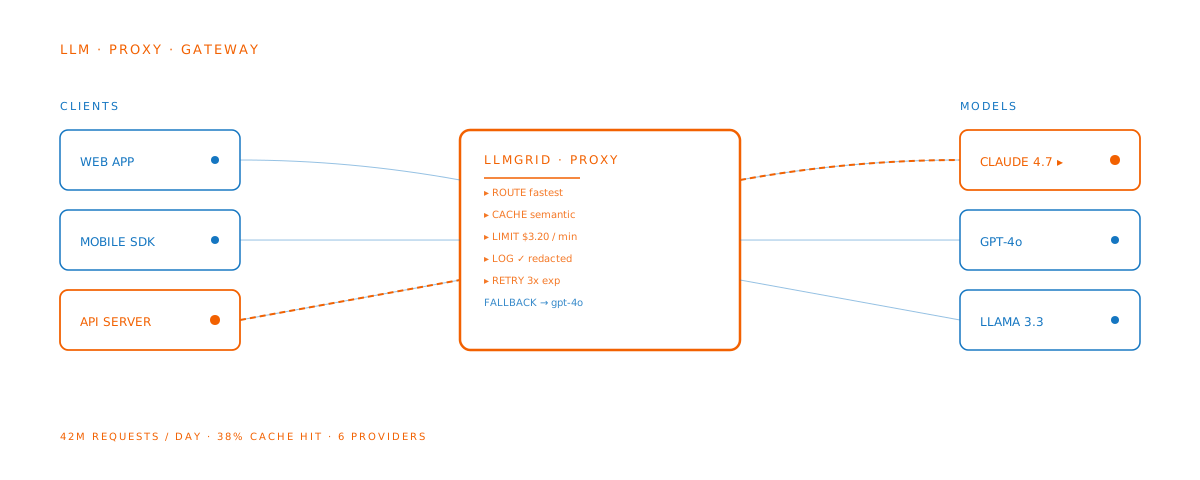
Watch a team scale an AI feature past the prototype stage and you’ll see the same pattern every time. Week one: one provider, one API key, hardcoded model name. Week six: three providers, quota errors, a Slack thread titled “why is Claude down?”, and a bespoke failover script that nobody wants to own.
At some point someone says the words “we should put this behind a gateway” and a six-month build begins.
LLMGrid.ai is that gateway, already built.
What a gateway actually has to do
The surface area of a real LLM gateway is not small:
- Unified API — one schema across OpenAI, Anthropic, Mistral, Google, Groq, Together, Bedrock, and local models.
- Routing — by cost, by latency, by capability, by compliance zone, by fallback chain.
- Observability — per-request tokens, cost, latency, cache hit, routing decision, full replay.
- Rate limiting — per-key, per-team, per-tenant, per-model.
- Cost attribution — chargeback to the business unit that made the call.
- Caching — semantic and exact, with invalidation you actually trust.
- Safety filters — PII, prompt injection, content policy, applied consistently.
- Key rotation — bring your own keys or use pooled keys, rotate without downtime.
Every team that scales past a handful of models ends up building this. Most build it badly because it’s not their core product.
What LLMGrid adds
LLMGrid wraps the gateway in the operational layer production teams need: a control plane, audit logs, SSO, team/project scoping, spend dashboards, and policy rules that operators actually want to write.
Where this goes
The next frontier is semantic routing — letting the gateway decide which model is best for a given prompt based on live quality signals, not static rules. That’s what we’re building next. The era of “hardcode the model name” is ending.
One API. 100+ models. → llmgrid.ai