
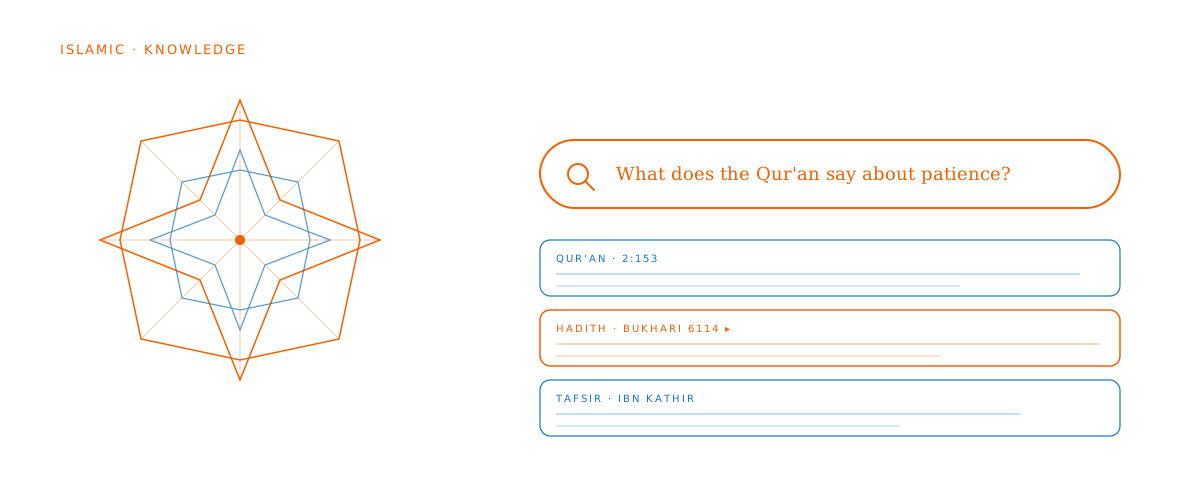
When you build an AI product for entertainment, a hallucination is an embarrassing bug. When you build one for Islamic studies, a hallucination is a category error. The content is sacred, the sources are canonical, and the user deserves to always know who is speaking — the text, the scholar, or the machine.
Three design commitments
-
The model never speaks as the text. Every quoted verse, hadith, or classical commentary is retrieved, not generated. The LLM is strictly an interface layer over a curated corpus.
-
Attribution is a first-class citizen. Every surfaced passage carries its source chain — collection, chapter, grade, scholar — rendered inline and unmissable.
-
The AI is clearly labeled. When IqraPoint paraphrases, summarizes, or guides, the surface makes it unambiguous that this is a machine speaking — never a scholar.
The retrieval backbone
The corpus is chunked by semantic units (a verse, a hadith, a tafsir block) and embedded in a dedicated vector index. Retrieval is gated by a canonical-source filter — we will never semantically match a user question against arbitrary web text. The answer space is the corpus, not the open internet.
Multilingual without mistranslation
We serve users across Arabic, Urdu, English, French, and more. Translation is fraught in this space — so we surface the original language alongside the translation, always, and clearly mark translation provenance. A user reading in English sees both what the translator said and what the source said.
Why this matters
AI will touch every knowledge domain in the next five years, including the ones with a thousand years of tradition behind them. The question for builders isn’t can we, it’s how do we do this with the respect the domain demands. IqraPoint is our answer for Islamic knowledge.
Explore IqraPoint → iqrapoint.com