
Ask any frontier LLM to “write in our brand voice” and you’ll get well-written copy that sounds like every other well-written copy on the internet. The problem isn’t model capability — it’s that “voice” is almost never captured as a spec. It lives in the heads of three senior marketers and dies there.
What a voice actually is
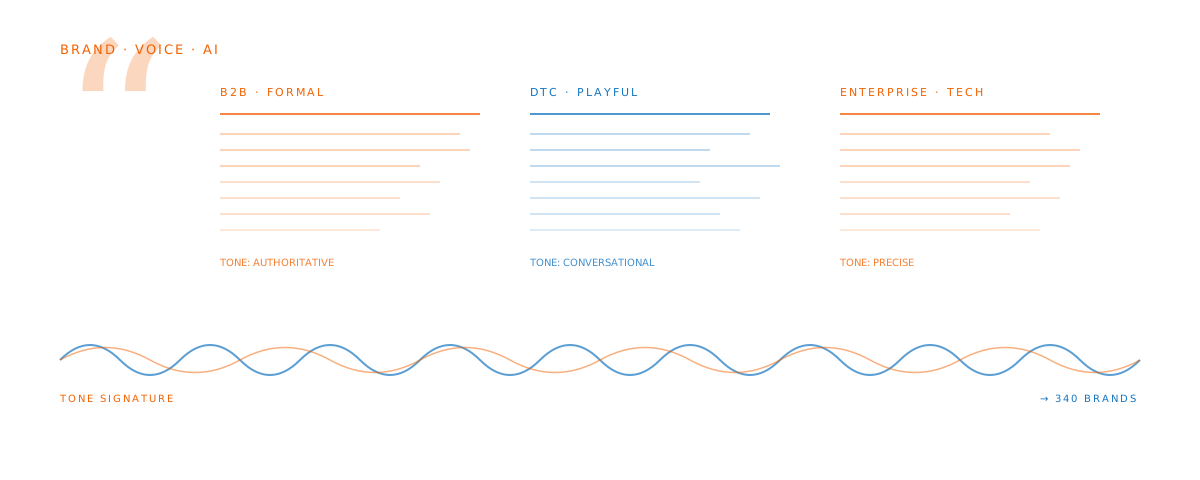
EzCopy.ai treats a brand voice as seven concrete dimensions:
- Lexicon — words we use, words we never use.
- Cadence — sentence-length distribution and rhythm.
- Posture — authoritative, conversational, cheeky, sober.
- Proof shape — do we cite numbers, stories, or analogies?
- Pronoun policy — we vs. you vs. the product.
- Formality gradient — where on the scale, and where we allow drift.
- Signature moves — recurring devices (e.g. “the case for X,” parenthetical asides, em-dashes, specific sign-offs).
Each of these compiles into a machine-auditable constraint that travels with every generation request.
Why one prompt isn’t enough
We don’t use a single “brand voice prompt.” We compose a stack: a voice spec, a channel adapter (email vs. landing page vs. social), an audience layer (prospect vs. customer vs. partner), and the actual brief. Each layer can be overridden, inspected, and versioned independently.
When the voice drifts — and it always drifts on long-running generations — we catch it with a voice-conformance classifier before the copy ever hits a draft.
The takeaway
“Prompt engineering” got a bad reputation because most of it is really just “typing harder.” Real prompt engineering looks like a compiler: structured inputs, deterministic transforms, testable outputs. That’s what we shipped in EzCopy.
Generate copy in your voice → ezcopy.ai